Driving anxiety: what helps, and what quietly makes it worse
Fear of driving is common enough to have a clinical name. Knowing its shape is the first thing that makes it manageable.

The formal term is amaxophobia, also called vehophobia or simply fear of driving. It covers a range that runs from mild reluctance through to a genuine phobia that stops someone getting into a car at all. Most people who describe themselves as a nervous driver sit somewhere in the middle: able to drive, but choosing not to.
That range matters, because the useful response differs at each end of it.
Where it comes from
Sometimes there is an obvious cause — a crash, a near miss, a frightening passenger experience, a bad early lesson with someone who shouted. Often there is not. A long gap since last driving will do it. So will passing the test years ago and never driving alone afterwards.
A common and under-recognised version: someone drives perfectly well on familiar roads and cannot face a motorway, a multi-storey car park, or a right turn across traffic. The fear is specific, not general, and it responds to specific practice.
Why avoidance deepens it
Avoiding the thing that frightens you works beautifully in the short term, which is the problem. Every avoided drive delivers immediate relief, and that relief is what teaches the brain the avoidance was necessary. The road gets a little bigger in your mind each time you do not drive it.
It also erodes the skill. Driving is perishable, and six months of not driving leaves you genuinely rustier, which makes the next attempt feel worse, which justifies more avoidance. The loop closes.
If anxiety about driving is part of a broader anxiety pattern, or if it is severe enough to affect work, family or sleep, that is worth raising with a GP or psychologist. Driving lessons are not therapy, and a good instructor will say so rather than pretend otherwise.
What a lesson looks like when you are nervous
Structurally different from a beginner lesson, even when the skills overlap:
- The first drive is deliberately too easy. An empty industrial estate on a Sunday, or a quiet back street. The point is not to learn anything. It is to have one uneventful drive in recent memory.
- Difficulty rises in small, agreed steps. You know before the lesson what is in it. No surprise motorway. Surprise is the enemy of a nervous driver, and an instructor who springs a challenge to "build confidence" has misunderstood the job.
- The hard thing gets broken up. A right turn across traffic is not one skill. It is gap judgement, positioning, clutch or creep control, and the nerve to commit. Practised separately, it stops being a wall.
- You keep the right to stop. Knowing you can pull over makes it far less likely you will need to.
The thing that actually shifts it
Repetition of the specific frightening thing, at a difficulty you can handle, often enough that it becomes boring. Not a pep talk. Not one heroic drive. Boredom is the target — the moment a manoeuvre stops producing any feeling at all is the moment it is learned.
Progress is usually uneven, too. A good week followed by a bad one is the normal shape of it, not evidence that it is not working.
Questions
- Is being a nervous driver something you grow out of?
- Not by waiting. Time alone tends to entrench it, because avoidance relieves the anxiety in the short term and erodes the skill in the longer term. What shifts it is graded practice at the specific thing you are avoiding.
- What is the difference between nerves and amaxophobia?
- Amaxophobia is the formal term for fear of driving, and it covers a wide range. Ordinary nerves make a drive uncomfortable. At the phobia end, the fear prevents driving altogether and can come with physical symptoms. If it is affecting your daily life, it is worth discussing with a GP rather than only an instructor.
- Should I tell my instructor I am anxious?
- Yes, and specifically what about. "I am a nervous driver" is far less useful than "I cannot do right turns across traffic" or "motorway merging frightens me". The second version can be planned around; the first cannot.
- Can I learn in an automatic to make it easier?
- Often it helps, because removing gear changes frees up attention for the road. It does leave an automatic condition on your licence, which is worth understanding before you decide rather than after.
- How long does it take to feel confident?
- There is no honest general answer, because it depends on what you are avoiding and how often you practise. The more useful measure is whether the specific thing that frightens you is getting duller with repetition. If it is, the approach is working.
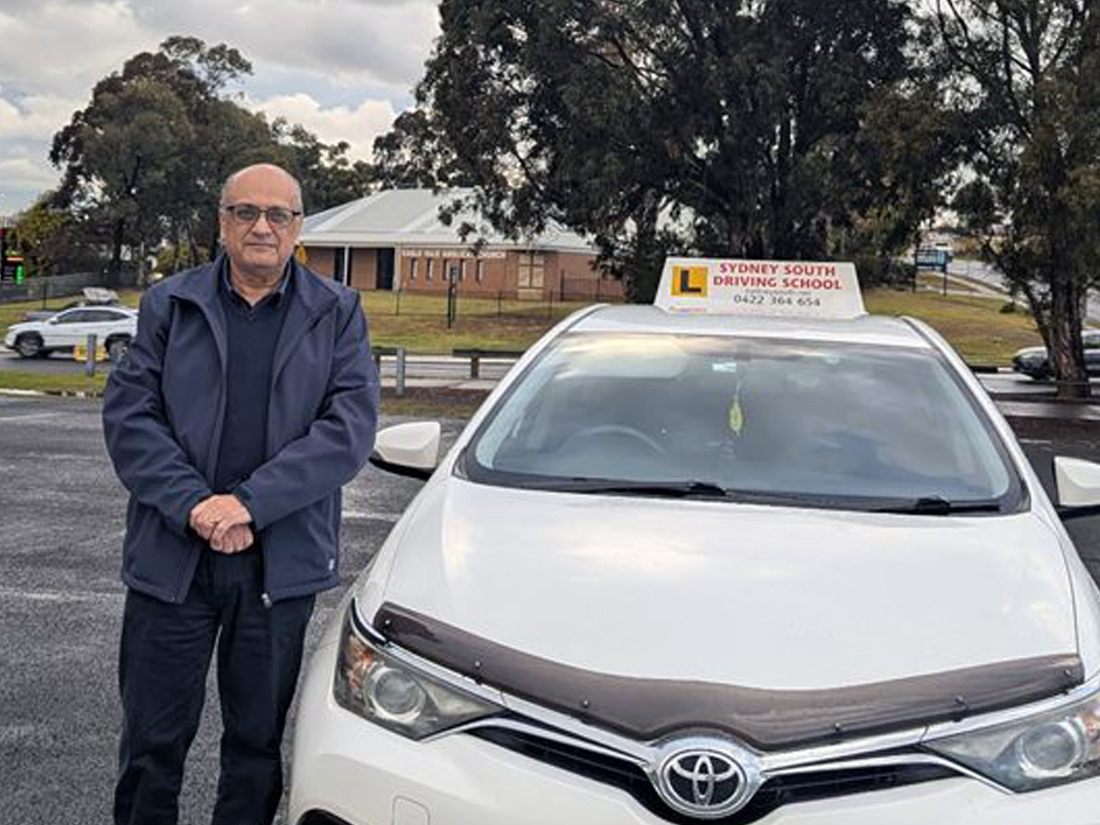
Senior driving instructor at Sydney South Driving School since 2013, with a Bachelor of Commerce and a professional background in accounting and five-star hospitality. More about Ashraf